Thursday, 28 April 2016

On "an-other" history

     The concept of ‘an-other’ is a tricky one to navigate. It is also one that most new historiographical approaches are foregrounded in: “an-other logic”, “an-other language”, “an-other thinking” and an-other history. What this idea of an-other does is that it first and foremost points towards a dominant theory/ idea and then tries to make room so that ‘an-other’ idea can be accommodated. When I think of the examples of this “other” its very interesting to me that while these alternative ideas claim at some level to be radical, they are  such that can in some ways co-exist with the dominant discourse. I realize all of these are abstractions. Let’s move to particulars.
       If we take the example of Shahid Amin’s articles on Gandhi and if we were to read it in conjunction with other histories (nationalist or otherwise) of  early twentieth-century India what imaginary of India would be formed? Would Shahid Amin’s article co-exist neatly with what has already been written or would it disturb it? There are multiple ways in which these ideas can co-exist and disturb what is already there before them. Ideas that co-exist can use what was before (Spivak’s criticism of the geopolitics of first-world feminism which travels), can read something in a new way to add to a particular idea (Ranajit Guha’s interpretation of colonial law in Chandra’s Death), can disturb the fabrics of what was woven before a text's existence (something that the subaltern collective aims to do). Interestingly, even when claims are made about the rewriting of history and the disturbance of various threads that are woven to create narratives, these texts co-exist with what was before.

       Is there any possibility other than this co-existence and simultaneity (that Mignolo identifies as historico-structural heterogeneity)? What would an actual radical break away from this model of co-existence and simultaneity look like, if it were possible? Is it also a question of language which makes whatever is imagined and presented as radical also submit on the altar of co-existence? What does the subaltern collective, and generally history from below, do when the differences that are said to separate these projects from the rest allow them to co-exist with what is already present? If co-existence, simultaneity and supplementarity are the limitations that are placed upon anything that becomes a part of an epistemic system, what does the outside look like and how can there be a disjuncture within the system if at all? 

Friday, 22 April 2016

Session 13

'The war of my life had begun; and though one of God's most powerless creatures, I resolved never to be conquered. Alas, for me!'

This line represents the entire contest in the book so far for me. Incidents in the Life of a slave girl cataougues instances of rebellion and agency in the torturous lives of slaves. We get to understand how these poor creatures, treated as 'chattle' show their resolve and grit. I found the particular scene where the grandmother is auctioned after her mistresses death extremely powerful. It showed how even the unlikliest of people have agency. A major theme in the book so far is that the slaves get immense agency if they have a good character and are skillful. Good character is respected by whites and they find their skill useful. This makes me sligtly question the agency of the slaves, because it is still derived from the same instituition of slavery and what it encompasses. The artistic mastery, talent, good faith etc of the honored slave are of little importance. It is his usefulness as a certain machine that is rewarded by honor. It is like giving more time off the leash to a good hunting dog. Nevertheless, the slave does have agency. And we see that, especially in the life of William. The way he says that he doesn't mind being whipped, but he dislikes the idea of it, resonates a powerful idea for me. It is not the actual beating, (for extremely horific cases of slaves being beaten to death may be a few) but the idea that one man owns another man in such a tangible, physical manner that is disturbing. 

Incidents in the Life of a Slave Girl

To comment on a narrative like Harriot Jones’ without being reductive is, for all practical purposes, impossible. The immensity of the experience that she communicates is, by her own admission, one that falls short of her reality. Rather than talk about the harrowing particulars of her experience, then, I have a more general observation to make. As we’ve seen from previous readings, it is a consideration of particular narratives that bring home the relevance of the general. What this reading did for me, more than any other, was drive in the extent to which the condition of subalternity dictates the terms of one’s existence. In the preface to the book, Harriot tells her readers that she was “born and reared in Slavery”. The phrase was probably commonly in use at the time, but coming from an emancipated slave, I can’t help but feel the significance of the way the circumstance is described. To say that one was “in Slavery”, as one would say “in the desert” or “in” anywhere, really, seems quite different than to say one “was a slave”. What I feel this does is really reinforce the nature of the conditions that create or enforce this particular form of subalternity. Obviously, to be in Slavery one must be a slave, but what comes through so strongly in the text is how the institution of slavery operates as an inescapable overarching narrative, as wholly responsible for determining experience as, say, climate.


In Harriot Jones’ story, this comes through most strongly when she speaks of the social rules governing marriage and the sexual exploitation of female slaves by their owners. Although her language is never explicit, there is a conscious portrayal of an awareness of their sexuality that comes to colored women living in Slavery very early on. This awareness permeates all levels of the household, even the white women are not exempt from it, although the consequences they suffer are obviously different. Harriot’s own struggle against the advances of her owner Mr. Flint are an example of this. She describes a spectrum of personal moralities that dictate these decisions amongst slave women, but also explains that none were exempt from a painful awareness of the sexual, regardless of their moral position. That the only escape she could find from Mr. Flint’s advances was to turn to Mr. Sands, is indicative of the extent to which she was defined in terms of her sexuality, and the extent to which she saw herself in terms of it. Harriot reflects multiple times on the fate of the children of white fathers that were born to slave women. These children were also born “in slavery”: they had to follow “the condition of the mother”. When her second child was born, she had no legal name to give it, she even describes feeling like she had no right to her own name. To possess the surname from their white father, as Harriot’s own father did, would not give them any sense of identity stemming from belonging to him; they did not even properly speaking belong to Harriot, but to Mr. Flint. There is a sense that, to be born in slavery is more than just to be born a slave. It is to be born of slave parents, to be destined to have children born slaves, to have one’s whole lineage in the control of a more powerful other, and to be forced to define and understand oneself through this circumstance above all others. To be subaltern then, to live in subalternity, is to be stripped of more than agency. It is more than being completely outside a hegemonic power structure, it is the condition of having that power structure influence not only what one does, but the very terms in which one perceives oneself.

Session 13

I would rather have titled this post hell because the account of Harriet Jacobs can only come from a place that is hell or worse. The account was persistently painful to read. It was unbearable on some places but that is because it is not a fictional tale but rather the reality of so many lives.

Despite all that I know about the subaltern I have never been more agonized with the thought of subalternity and how it attaches itself to someone making them voice-less. There were so many things that came to mind while reading this painful account. And I would like to approach this particular blog more personally than I have ever done so before.

The first time I truly related tot he text was when Benjamin says after being caught in his journey to freedom, "No, I did not think of him. When a man is hunted like a wild beast he forgets there is a God, a heaven. He forgets every thing in his struggle to get beyond the reach of the bloodhounds."
This told me how the hardship of the level that the slaves endure can drive them either way and this came into contrast with what I know or have read about the slaves and how they turned to Christianity in order to justify the hardships they bear. Some or even most of them did but there were some who refused to have faith on a cruel divine.

The other thing that I noticed was how blackness or color is a common feature associated with slaves or slavery, yet Harriet Jacobs makes a comment in her account at the time when her master has started making advances towards her, "No matter whether the slave girl be as black as ebony or as fair as her mistress. In either case, there is no shadow of law to protect her from insult, from violence, or even from death; all these are inflicted by fiends who bear the shape of men." So there are certain attributes of this condition that will apply to just one gender. The other reason why being a woman AND a slave is also a much more horrible place to be is because a woman's worth is only valued by if she increases her Master's stock of slaves as Jacobs points out. All of this is a testament to the intersectionality and how a person can be the subaltern buried under so many different layers of subalternity. For instance the mother slave is silenced in all accounts. She has no control over he her own life or body or sexuality. She has no control over her own marriage or relationships. She has no control over whose child she bears and even when she has born her masters child, she has no control over their condition and where they might be taken or what might be made of them. And this applies to so many others.

Another thing that came to light when I was reading was the idea that even though the slave is dehumanized in the eyes of the master, on a certain level this dehumanization is reciprocated when the slave holders are referred to as blood hounds or when their hearts are called a "mystic clock that beats in their chest and they are deaf to it".

I inferred from this that it feels better to dehumanize one's attackers and torturers because it is easier to say that a monster did these horrible things than to say that another human being did these horrible things.

The torture of the life of a bond-man or a bond-woman is experienced so deeply and is a violation that is so great as Jacobs says, "I know that some are too much brutalized by slavery to feel the humiliation of their position; but many slaves feel it most acutely, and shrink from the memory of it."
It is unbearable to imagine how these brutalities left scars that couldn't possibly heal and even if they could, they didn't until the end of their lives.

A question that came to mind constantly was where d I find the subaltern or who is the subaltern. It is the slave girl, it is the slave girl's brother or her uncles or her mother or her father or ever her mistress who was distressed by her husband to an extent. If I take spivaks definition of how the subaltern is excluded from the access to power structures then I must say apart from the very wealthy slave owners  I become inclined to call several of the people mentioned in jacobs' account the subaltern. Subalternity in my opinion was a characterisitic that attaches itself to these people, to some more than others but in most ways it silences them not because they cant speak but because their voice isn't part of the dominant narrative no one is willing to hear them. They are simply not heard. The other thing that it very obviously does is that strips the subaltern from any agency. Even the mistress of the happy family when married to her slave holding husband was incapable of stopping any of the horrific acts he did on to her slaves, The lack of agency finds the slaves from birth but can manifest in so many ways later in life. 

Random South American Subalterns


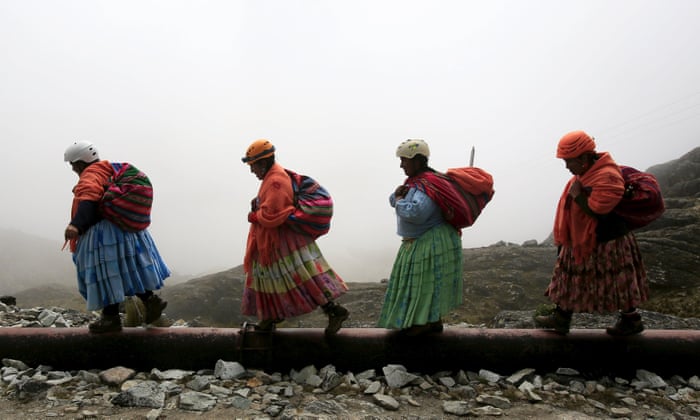
This was in yesterday's news and it's quite an uplifting story.

It's interesting how these Bolivian women have chosen to exert their agency, find a voice etc, in a very modern way (professional mountain climbing) but have retained the unique markers of their specific Aymara identity in the shape of their orange shawls and their wide skirts.

Just in case any of you might be interested.

http://www.theguardian.com/world/2016/apr/21/bolivia-mountain-climbers-women-cholita-aymara-illimani-peak-summits

http://www.theguardian.com/world/gallery/2016/apr/21/bolivia-cholita-climbers-mountains-ayamara-women-gallery

April 22 Blog


  • Jacobs’ narrative is obviously powerful and moving. It cannot help being so since it is an account of the treatment meted out to black Americans in the nineteenth century.
  • It is surprising in its sophistication. Jacobs’ ideas are complex and very well articulated. Incidents in the Life of a Slave Girl broadly reads like any other mid 19th century work of prose. Because of its subject matter, it especially reminds one of Uncle Tom’s Cabin by Harriet Beecher Stowe.
  • There is nothing in the text itself to indicate that this is the work of a black woman. I do not mean to cast doubt on Jacobs’ authorship but simply to point out the oddness/bizarreness of the fact that black American slave experience with all its specificities and uniqueness has been expressed through the unmodified white bourgeois idiom of the day. An enormous amount of authenticity will naturally have been lost in the process.
  • For example: at one point, Jacobs' grandmother (a lifelong slave and very probably illiterate) is recalled to have said “O Linda! Has it come to this? I had rather see you dead than to see you as you now are. You are a disgrace to your dead mother.”
  • The grandmother’s words, having been given this shape, would make their way to the hearts of Jacobs’ white middle-class readers. This is in line with more straightforward appeals to shared common humanity. For instance, when Jacobs tells her readers that a black woman's love for her children is the same as a white woman's love for her children.
  • In her introduction, Maria Child explains Jacobs’ style of writing and general parhi-likhi-ness by telling us that when she was a young girl, Jacobs had a kind mistress who taught her to read and write and that Jacobs had considerably supplemented this learning during her time in New York by reading and by conversing with educated and intelligent (presumably white) people.
  • Child rather loosely tells us that “At her request, I have revised her manuscript; but such changes as I have made have been mainly for purposes of condensation and orderly arrangement.”
  • Even if we take Child’s word for it and believe that Jacobs's words are largely her own, a poststructuralist reading of Incidents in the Life of a Slave Girl should pay attention to the fact that the stock of signifiers that is available for Jacobs to use in her written story, the very language that she uses, has been created by the hegemonic discourse around her. Its limitations therefore have to be kept in mind.
  • In light of all this, the introduction to this Penguin edition of the text comes across as unduly confident in its claims. In the first paragraph alone, I was made uncomfortable at several points. Jacobs is referred to as an “African-American” – a term that wouldn't come into existence until long after her death. We are also told that Jacobs was “thoroughly feminist”. The first wave of feminism only came into its own in the early twentieth century. Jacobs is being retrospectively assigned categories that might not have meant a great deal to her. (Which is obviously not to say that she did not share these concerns, but simply that she wouldn't have experienced them in the exact same terms that a late twentieth century academic would.)
  • Here is a very short excerpt from a book I read for another course. I think it is relevant to my blog. https://www.dropbox.com/s/3wcwhge6q0r35ic/Truth.pdf?dl=0

Week 13


This week’s reading shows in great detail how the theories of subalternity can apply to history and why the voiceless-ness of a subaltern is a defining feature of her existence. While the voice of an oppressed individual can be considered legitimate, the voice of a subaltern will not be considered valid unless it is in terms of the dominant mode of hearing. Linda’s lack of control of her sexuality is an important example of this case.

In an earlier chapter we told of a situation where Dr. Flint is accused of being the father of one of his female slaves’ children. In response, Flint whips the accusing husband nearly to death and a year later, has the couple shipped away so that they are “out of sight and hearing”. We discover that the slave women had been promised better treatment in return for her assent, but despite this, Dr. Flint has the woman sold to protect his own reputation.

Linda is made a similar offer but she refuses. Linda’s subordination to her master, Dr. Flint, is defined to a large extent by the lack of control she has over her sexuality. In these conditions, Linda is able to exercise her agency only through acting along this defining feature of her subalternity; she chooses to take Mr. Sands as her lover in the hope that Dr. Flint agrees to sell her.

The result is that Linda is ostracized by everyone, including her grandmother and Mr. Sands refuses to value her even after she bears two of his children. Linda attempts to escape her subalternity, but ends up reinforcing the dominant mode of being; she is no closer to being freed and is still exploited.